

The attack surface isn't disabled. It's removed.
Privacy OS is a hardened, Android-based operating system built for people and organizations who can't treat 'off' as good enough. We don't toggle off Bluetooth, GPS, and sideloading. We strip the code out entirely, then support only the verified apps you actually need.
Your phone was built for convenience. Adversaries are counting on that.
Commercial smartphones ship with dozens of always-on radios, background services, and open install paths. Every one of them is a door, and most owners never know when one gets opened.01 — Radios
Zero-click radio attacks
Bluetooth and baseband exploits compromise devices with no tap, click, or download required.
02 — Tracking
Silent location exposure
GPS and fused location run continuously in the background, even when "location services" is switched off.
03 — Sideloading
Unverified app installs
Open install paths let spyware and malicious apps land on a device outside any admin's visibility.
04 — MDM
Toggled, not removed
Standard MDMs only disables risky features, leaving underlying code that can be re-enabled by malware.
Switched off can be switched back on. Removed can't.
Most mobile security is a policy layer sitting on top of unchanged commercial firmware. Spyware vendors build entire businesses around silently reversing those policies. Privacy OS closes that door by rebuilding the OS itself.
The code is gone
- Bluetooth is removed at the Hardware Abstraction Layer, so there's nothing to re-enable
- Location and fused location code is stripped from the OS entirely, not toggled off
- Device management is built into the Android System Server, with no separate app to attack
- Continuous OS-level threat detection watches everything that's left

The code is still there
- GPS, Bluetooth, and NFC drivers remain fully installed, just policy-disabled
- Commercial spyware can silently re-enable radios without user or admin knowledge
- MDM runs as an app, itself a target for privilege escalation
- Security depends entirely on the app layer, not the OS underneath it
Spyware needs a way in. We remove the ones it relies on most.
Beyond radios and location, two of the most common delivery paths for commercial spyware are the telephony stack and the browser. Both are removed at the code level in Privacy OS.
Telephony Package Completely Removed
SMS, MMS, and emergency alerts are stripped from the operating system entirely. These channels have historically been used to deliver zero-click payloads without any action from the user, and on Privacy OS they simply don't exist to exploit.

Browser Package Removed
Most spyware needs browser access to pull down and execute its payload. We've removed that code to close off the path.
Depending on the applications you choose, some require access to WebView components in order to function. In that case, that specific code is reintroduced.
It doesn't just resist attacks. It watches for them, live.
Privacy OS runs continuous, OS-level monitoring so your team sees a problem the moment it happens, not weeks later during an audit.

24/7 Remote Logging with SOC/SIEM Integration
Device activity streams straight into your existing security operations center or SIEM platform, around the clock. No separate dashboard to babysit, no gaps in coverage between shifts.

Baseband Attack Monitoring
The baseband processor is one of the least visible parts of any phone, and one of the most targeted. Privacy OS watches it directly for the radio-level exploits most security tools never see.

Active and Passive Threat Detection
Passive monitoring builds a constant picture of normal device behavior. Active detection hunts for the specific signs of compromise, rooting, tampered binaries, and cloaking apps, then flags them in real time.
You don't need a dozen vendors to complete your checklist.
Many organizations piece together mobile security using separate operating systems, MDMs, secure messaging platforms, compliance tools, and endpoint protection products. The result is higher costs, increased complexity, and more places for things to go wrong. And when vendors offer overlapping capabilities, you're often paying multiple times for features you only need once.
Myntex brings these critical capabilities together in one integrated platform, making it easier to deploy, manage, and secure your mobile endpoints while reducing operational overhead, unnecessary overlap, and potential security gaps.
ExpandCollapse
Device & Application Management
- Endpoint Management
- Device Enrollment
- Application Management
- Application Control
- Identity & Access Controls
- RBAC & Administration
- Centralized Management
- Secure Provisioning
- Field Device Management
- Audit & Reporting
Communications & Hardware Controls
- Secure Communications
- Encrypted Messaging
- Encrypted Voice & Video
- USB Control
- Bluetooth Control
- NFC Control
- GPS Control
- Sideloading Control
- Secure Package Delivery
Endpoint Security
- Mobile OS Security
- Device Integrity
- Threat Detection
- Security Response
- OS & OTA Updates
- Policy Enforcement
- Device Compliance
- Remote Lock & Wipe
Deployment & Infrastructure
- Private Deployment
- On-Premises Deployment
- Air-Gapped Deployment

Removed Attack Surfaces
Location Services
Location and fused location code is fully stripped from the OS, not just disabled.
Bluetooth
Removed at the Hardware Abstraction Layer, eliminating proximity-based attack vectors.
GSM Calling, MMS & SMS
Standard telephony is eliminated, protecting against zero-click baseband attacks.
Google Services & FCM
Replaced with proprietary secure socket tunneling, no data touches Google infrastructure.
Web Browser
Removes the delivery path behind the majority of zero-click and one-click exploit chains.
Emergency Alerts
Closes an attack surface that has been used to remotely infect devices via alert exploits.
Immune to SIM Swapping
Authentication bypasses carrier identifiers entirely, eliminating SIM-swap risk.
USB Data Disabled
Charging is preserved while unauthorized data transfer and enumeration are blocked.
Screen Capture
Screenshots and screen recording are disabled at both the system and ADB level.
Clipboard Locked by Default
Copy/paste is off unless explicitly enabled, guarding against data extraction.
Overlay & Accessibility
Unauthorized overlays and accessibility services are permanently disabled to stop credential theft.
Active Protection
Active Threat Detection
Continuous checks identify unauthorized packages, cloaking apps, and tampered binaries.
Verified Boot
Cryptographic integrity checks trigger a self-destruct sequence if an unlocked bootloader is detected.
Mobile Device Management
Core-level management in the Android System Server, tamper-resistant policy enforcement.
Emergency Reset
Hold the power button to trigger a one-step wipe. No menus, no delays.
Duress Password
A secondary password instantly wipes the device and returns it to the activation screen.
Asset Loss Prevention
A factory reset on inactivity destroys all data if a device is lost, stolen, or expires.
Automatic Restart (BFU Mode)
Scheduled restarts clear residual data and re-arm Before First Unlock protection.
Fingerprint Timeout
Biometric auth deactivates on a timer, forcing a secure password on a set cadence.
Private Keyboard
Spell-check runs locally, no keystrokes ever leave the device.
Camera Metadata Scrubbing
EXIF metadata is stripped automatically from every photo taken.
Gallery Auto-Purge
Media is permanently deleted after a configurable window of 3 to 90 days.
Severeign Data Centers
Private, single-tenant infrastructure with zero third-party reliance.
NIAP-Certified Hardware
Built on NIAP-validated Pixel hardware with a Titan M2 security chip.
NATO CAGE & DUNS Certified
Registered for streamlined vetting across defense, intelligence, and enterprise procurement.
No Play Store. No sideloading. No surprises.
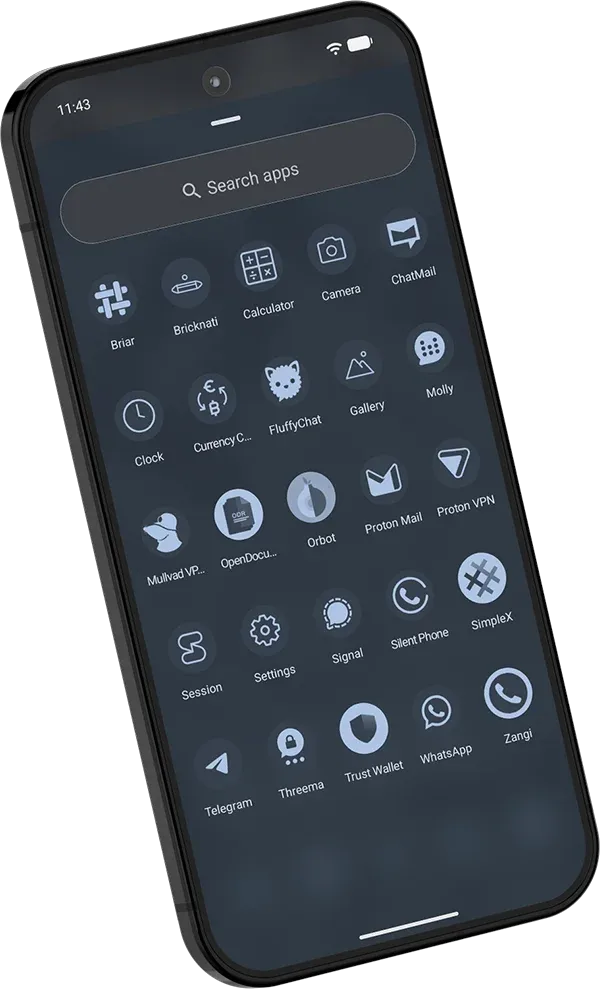
There's no app marketplace on the device and no path to install anything outside of it. The administrator defines exactly which applications are permitted, and that's the complete list. Nothing more can land on the device, by policy or by accident.

Admin-defined allowlist
Only pre-approved apps are ever installable, and everything else is architecturally impossible, not just against policy.

MDM built into the OS core
Device policy runs at the Android System Server level, not as an app, so neither an employee nor spyware can tamper with it.

 Approved
 Approved
 Approved
 Approved
 Approved
 Approved
 With Review
 Approved
 Approved
 Approved
 Approved
 Approved
 Approved
 Approved
 Approved
 Approved
 Approved
 Approved
 Approved
 Blocked
 Approved
 Approved
 Approved
 Approved
 Approved
 Approved
 Approved
 Approved
 Approved
 Approved
 Approved
 Approved
 Approved
 Approved
 Blocked
 Approved
 Approved
 Approved
 Approved
 Approved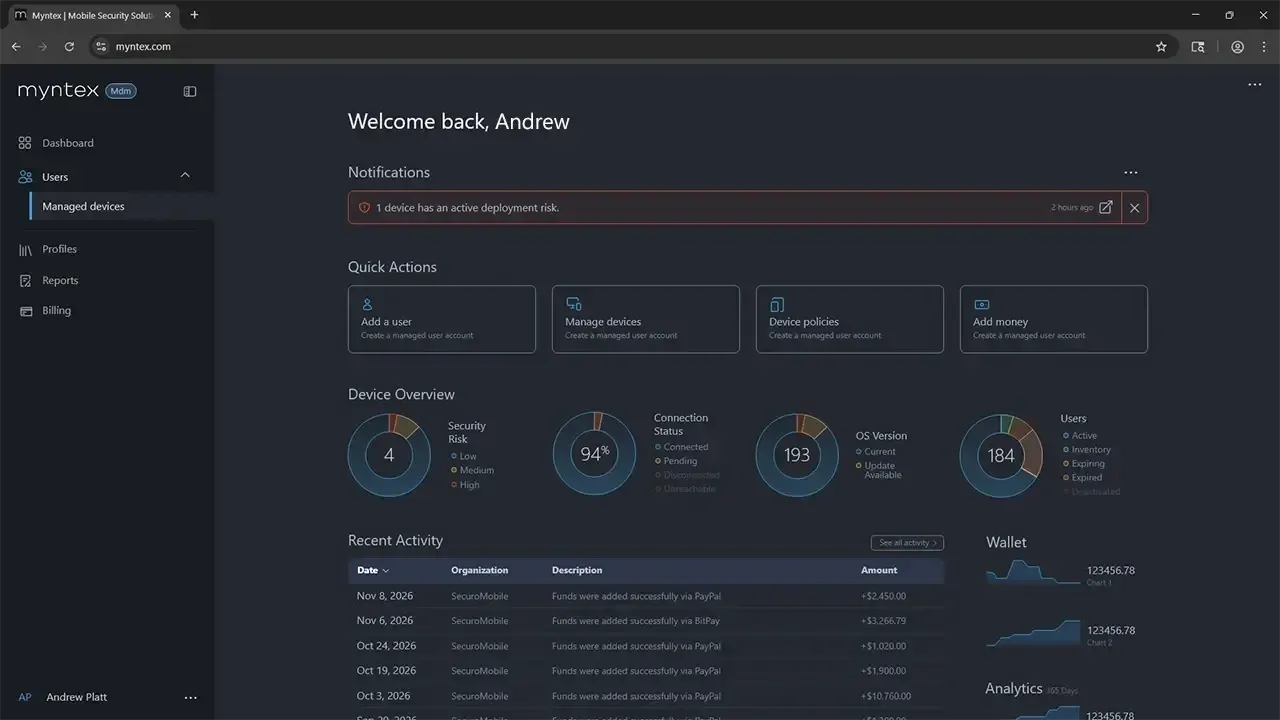
Architected for security. Unified for efficiency.
Other providers add an MDM and threat detection on as separate, licensed apps sitting on top of unmodified Android. We build both directly into the operating system: one deployment, deeper visibility, no third-party attack surface to license, manage, or defend.
- Core-level MDM in the Android System Server, tamper-resistant by design
- 24/7 remote logging with SOC/SIEM integration
- Baseband attack monitoring plus active and passive threat detection
- One deployment, one vendor relationship, no add-on licensing overhead
Run the whole fleet yourselves. No call to us required.
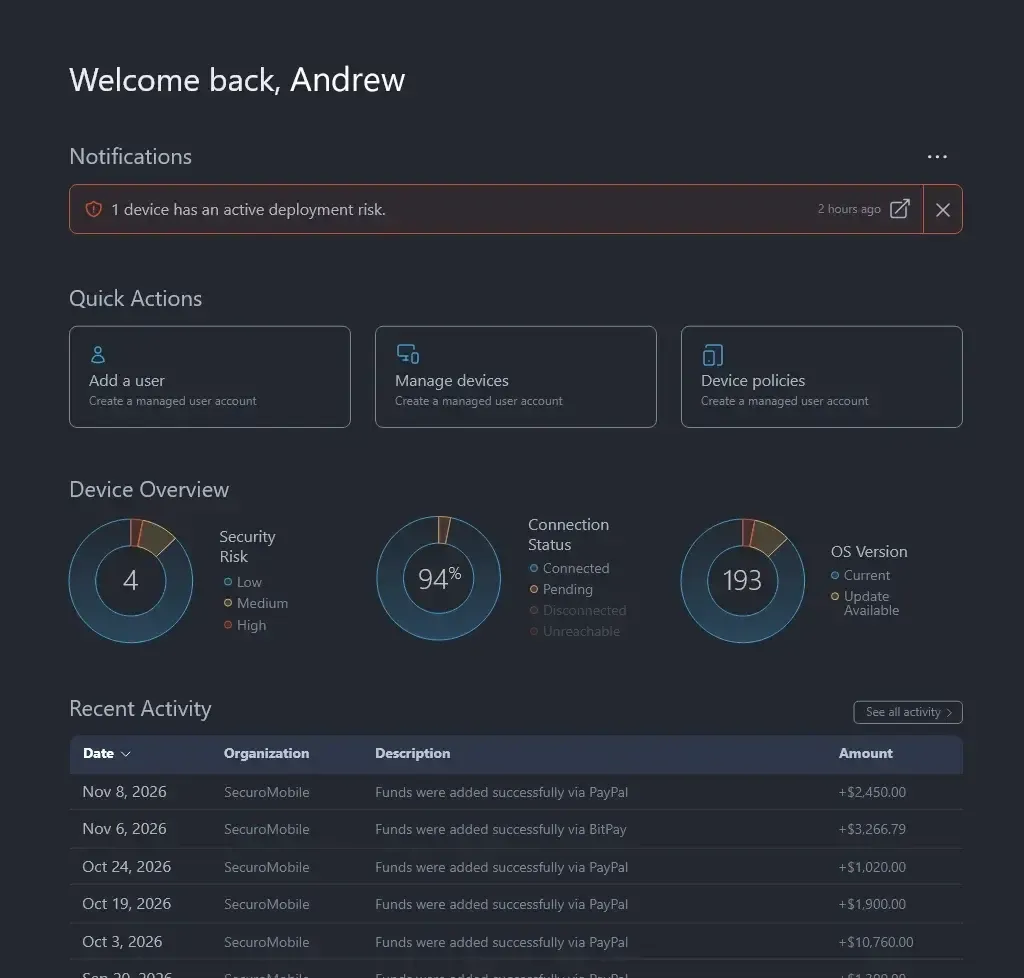
Everything an administrator needs to manage a deployment lives in one self-service portal. Add or remove users, update the approved app list, pull logs, or wipe a lost device, all without waiting on a support ticket.
- Manage every enrolled device from a single dashboard
- Update the approved application allowlist in real time
- Trigger a remote wipe the moment a device is lost or stolen
- Review logs and alerts directly, or export them into your SIEM
One hardened foundation. Three very different missions.
Privacy OS ships off-the-shelf or fully customized, with the same OS-level protection, tuned to what each kind of deployment actually needs.
For people who choose privacy
You don't need to be a high-profile target to care about your privacy. Your conversations, photos, location, and personal information belong to you.
Privacy OS is for people who choose to take an extra step to protect the way they communicate and use their devices.
- Choose the messaging and VPN applications you prefer, without opening your device to an unrestricted app ecosystem.
- Reduce your digital footprint by removing unnecessary tracking and connectivity features rather than simply switching them off.
- Make privacy the default with a deliberately limited environment that gives you greater control over what gets access to your information.

NIAP-Certified Hardware
Built exclusively on NIAP-validated Google Pixel hardware, meeting federal Protection Profiles via Titan M2 hardware-rooted encryption.
NATO CAGE Codified
Registered with NCAGE certification, validating readiness for direct procurement across allied defense and intelligence operations.

Sovereign Data Centers
Infrastructure hosted entirely within our own private data center in Calgary, Alberta. No cloud, no third-party reliance, single-tenant from end to end.

16 Years in Secure Comms
Over a decade and a half delivering enterprise-grade, sovereign mobile security to clients worldwide.
 Pixel 7aPixel 8aPixel 9aPixel 9Pixel 9 Pro
Deploy it your way, under your name if you need to.
Privacy OS was designed to fit into how your organization already operates, not the other way around.
Self-Hosted for Full Sovereignty
For governments and agencies that require complete control over their own infrastructure, Privacy OS can be fully self-hosted on your own environment, with no dependency on our data center.

White Labeled to Your Brand
Privacy OS can be rebranded entirely as your own, from device naming to portal styling, so partners and integrators can offer it as a natural extension of their existing platform rather than a separate third-party product. Configure your own version.
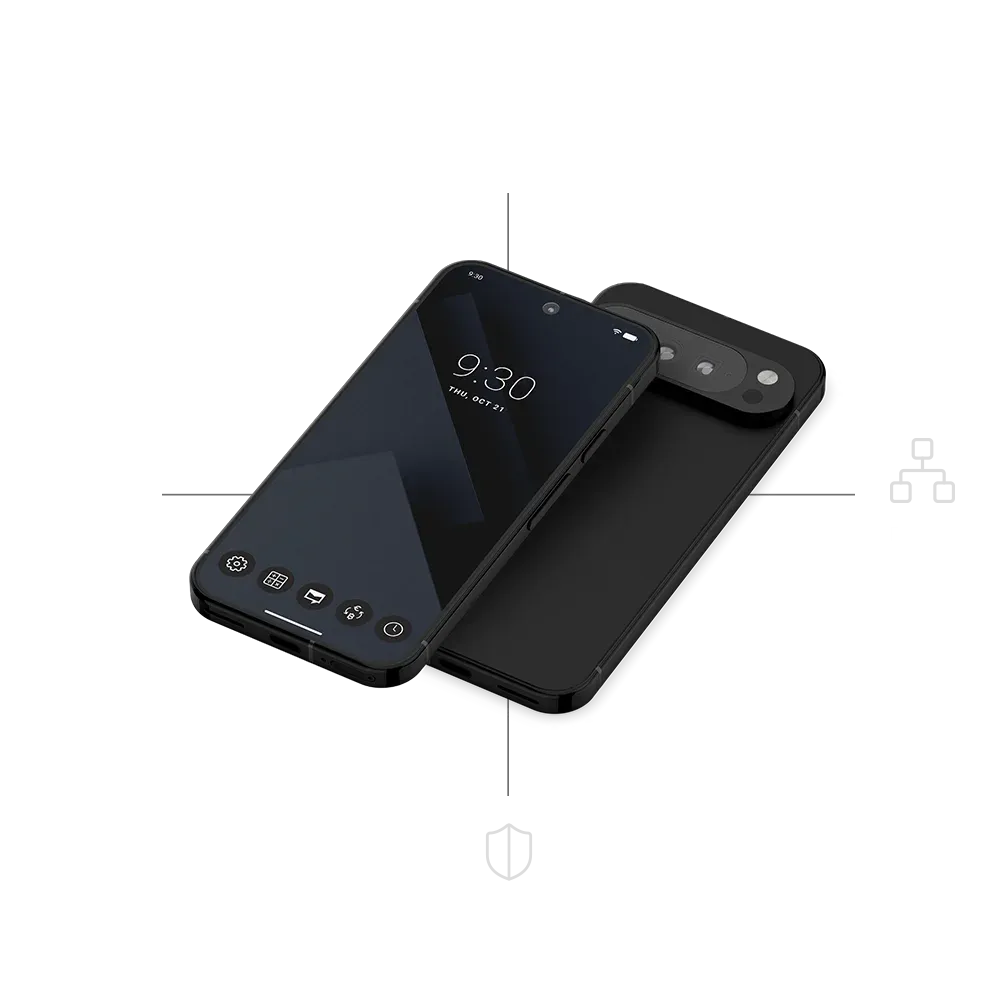
One cost. One vendor. Nothing to stitch together yourself.
No separate licenses, no separate support lines, no gaps between products built by different companies. All the software comes from Myntex, as one package.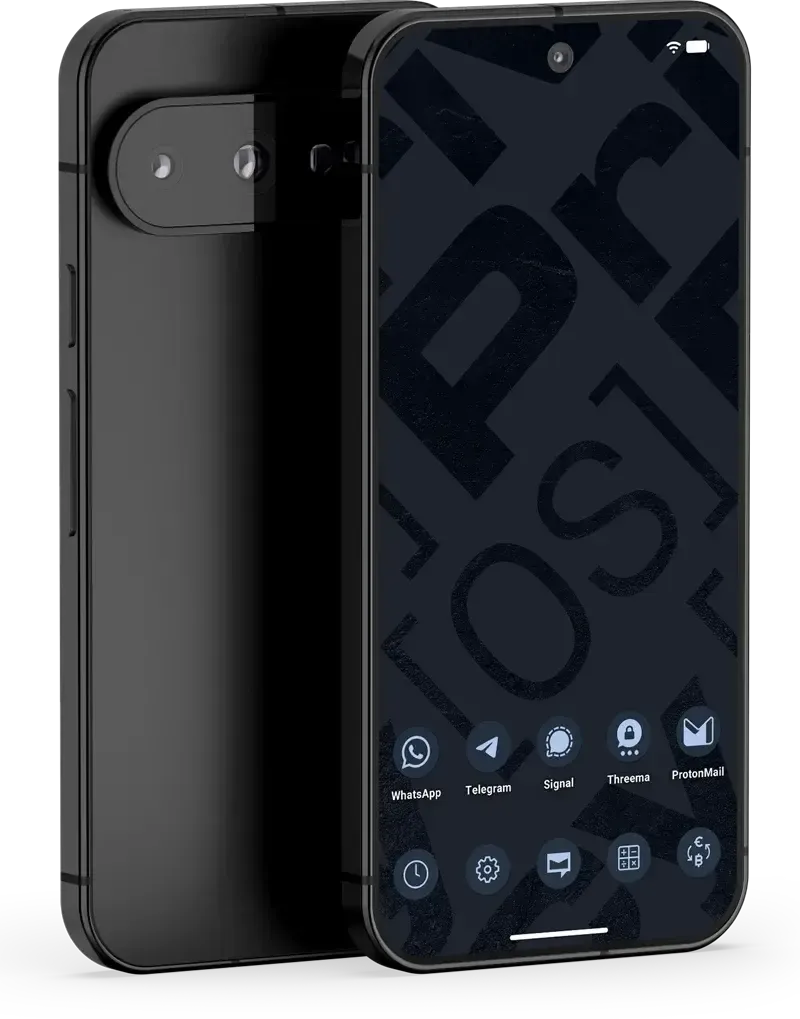
Reduce your attack surface today with Privacy OS.
Off-the-shelf or fully customized to your deployment, talk to us about what Privacy OS looks like for your team.